Session 58 — February 2020
Homeopathy, the placebo effect and energetic healing ▶ Play excerpt10:28

Frederic asks whether homeopathy has any effect beyond placebo, having seen studies suggesting it does not.
The Wonders say it absolutely does, affecting the physical, mental and emotional and even the spiritual depending on circumstances.
They explain that those conducting the studies set out to prove it does not work, and a study designed to prove something will find a way to do so.
The homeopathic effect is very subtle: a pharmaceutical is like a sledgehammer to a nail - effective when it hits, but damaging the surroundings and other things when it misses - whereas homeopathy is like a tiny tuning fork slowly but surely driving the nail in over time, and researchers want to see the sledgehammer impact rather than allow the time the other approach needs.
Frederic then asks whether, since homeopathy works energetically, a physical substance is needed at all, and whether placebo works the same way.
The Wonders answer that someone aware enough to shift themselves energetically would need nothing, but most humans carry a psychology of necessity for interference in the body; homeopathics, though essentially energetic because the substance is so minute, are still viewed as interference, which is why placebo can be as effective as homeopathy - and in some cases as pharmaceuticals - since any pill carries the idea of interference, letting the mind assume energetic movement and, moving out of the conscious into the unconscious mind, allow energy to move through and heal the body.
They note the irony that those who work to disprove homeopathy discount the placebo effect when validating chemical constructs while using it to dismiss homeopathy.
They cite the Asimaya technique as a purely energetic healing method given to humanity, in which the physical components - hand movements and symbolism, even vocalizing the word - exist only to satisfy the mind's need for interference; simply choosing energetically to move would require a real shift in consciousness.
When Frederic proposes that subtler energy is more powerful, they correct him: it is not subtlety but allowance that is powerful, that is, less interference.
They contrast antidepressants such as Xanax or Zoloft, which act fast on hormone chemistry but carry side effects from fuzzy thinking to circulation and heart problems, with homeopathy, which does the same more subtly over a longer period - unappealing in a society sold on immediate gratification, even though moving purely energetically would give truly instant results.
Because the mind wants a how-to, a technique or a control mechanism, energy will not produce the same results unless a methodology to access it is provided, which is what Asimaya does.
Frederic mentions techniques for reaching a state of 'nothing' with less or no interference, which he cannot sustain long yet which seems to have an impact.
The Wonders describe Huna practitioners who dramatically reach into bodies and pull out disease so that people can see a physical component: it is not the practitioner who heals but the patient who at that moment chooses to heal themselves.
Time, space, the triple axis and nothingness ▶ Play excerpt06:21
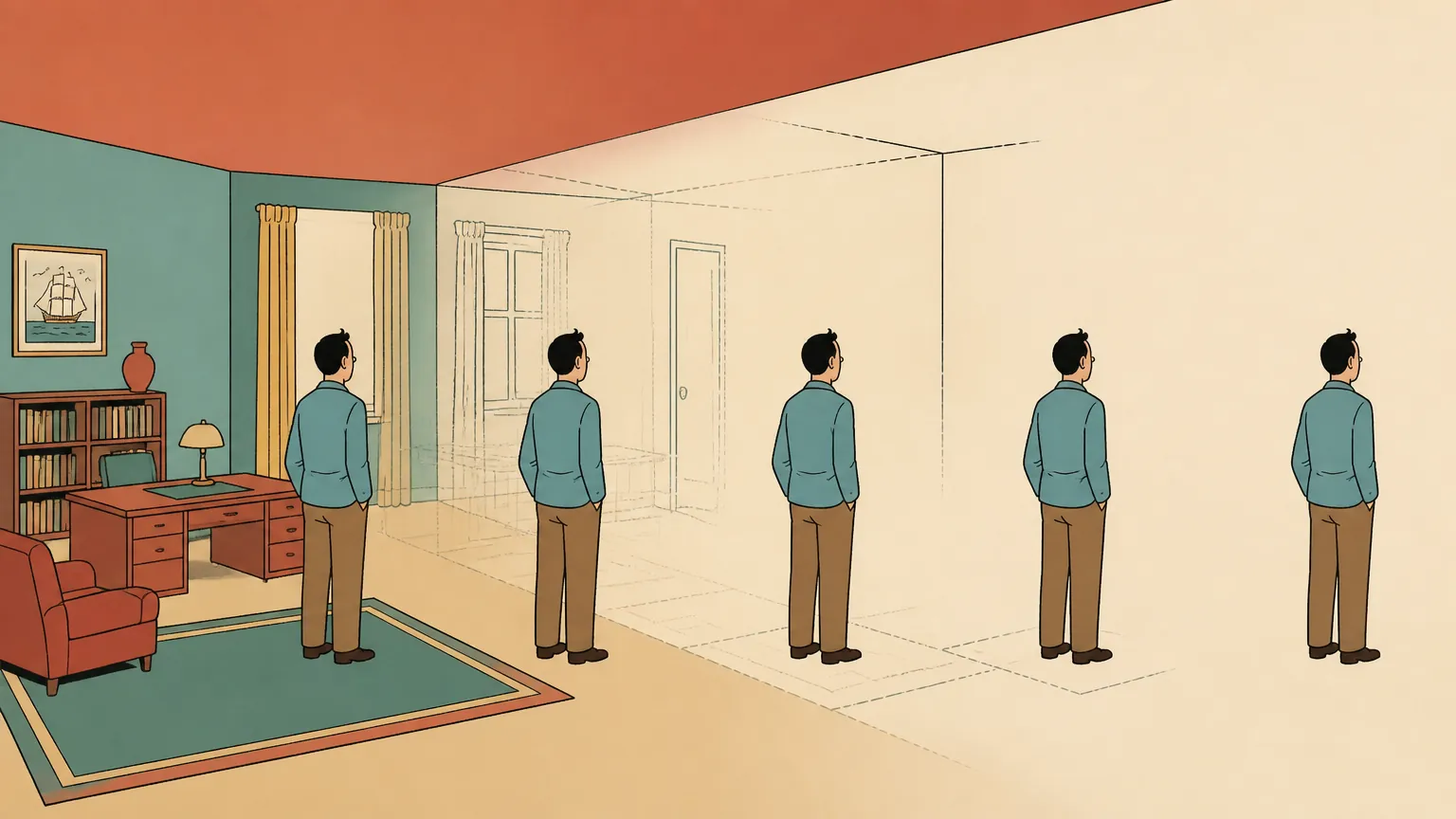
Frederic says he can imagine the absence of time, or everything happening at once, but finds space far more prevalent and cannot conceive of no space.
The Wonders question whether he can truly imagine no time, and point out that his mind is attached to time and space as linear and interdependent - the subject matter of quantum physics - so that even reconceiving time as elliptical does not alter the relationship to space, whose structure seems to remain.
They propose instead taking the triple axis of width, length and height and removing those concepts, which leaves something spacious that is not space itself; from there one can observe that existence can move through spaciousness without being defined by the limits of the triple axis.
Frederic asks whether this explains why focusing on something very small sends him to somewhere very large, and they confirm it, while noting that his mind moves inward and creates spaciousness still built on the triple axis, which is exactly what he has trouble getting beyond.
Their suggestion is that in meditation he simply ask what existence would be without the triple axis, without defining or forcing an answer, and see what occurs - he may arrive at a new and broader understanding of space, then eventually find that understanding limiting too and see beyond it, until reaching the realization that nothingness allows everything, a concept the mind finds hard to accept.
Frederic says nothingness has always fascinated him, and they urge him to keep exploring, since the only way to help the mind detach from its limitations is to explore beyond them.
In the post-session reflection the channel notes that even looking at air or empty space, the mind still contains it within length, width and height and insists on infusing limits despite knowing the concept of limitlessness; removing that relationship leaves nothing, raising the question of how to define, express or explore that nothing - conversations he says he had with himself 20 and 30 years ago and now finds comparatively uninteresting.